
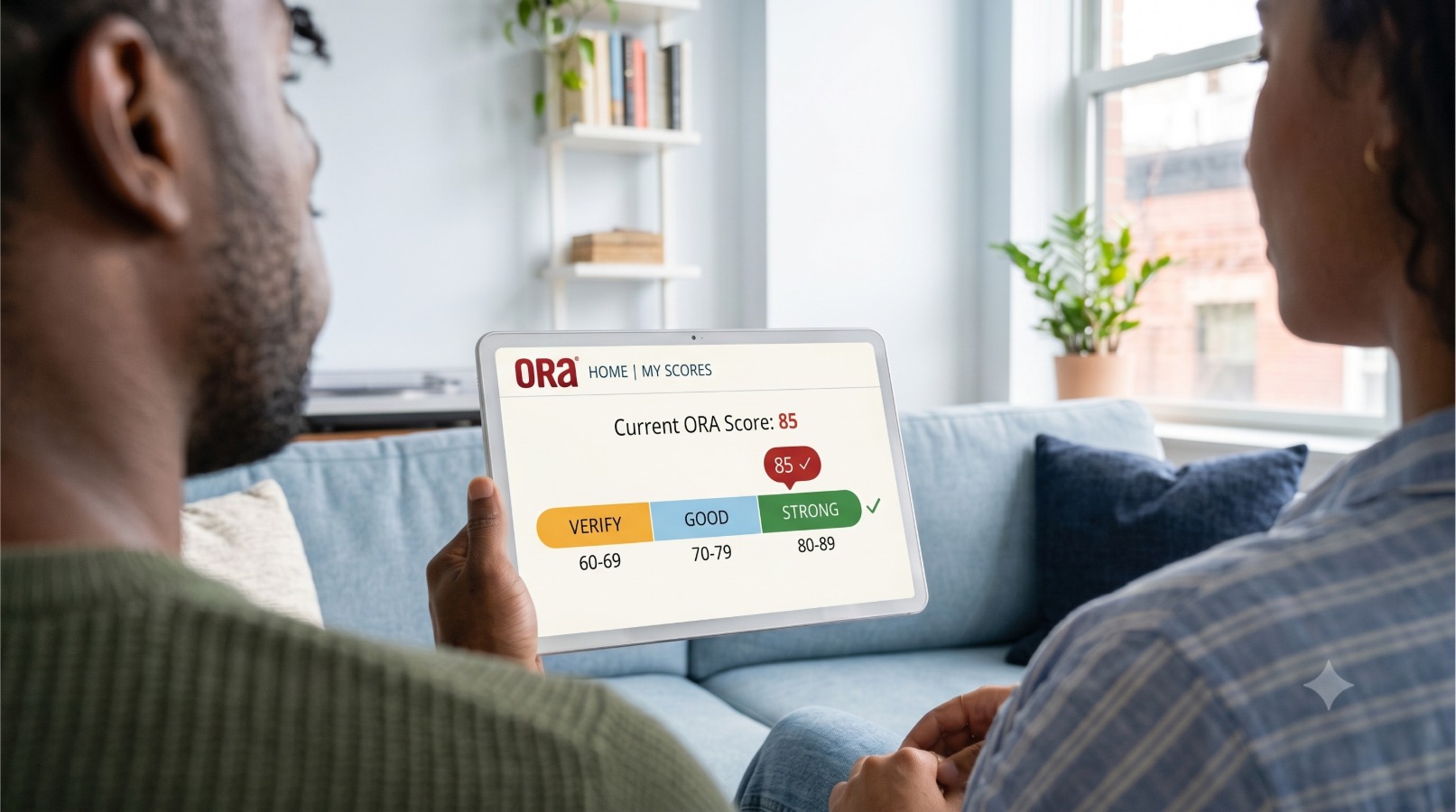
If you are comparing apartment communities, you have probably wondered what counts as a “good” The ORA® Score and whether a score difference actually matters.
The short answer is yes, but context matters.
ORA® is designed to help renters compare apartment communities using resident experience signals, not marketing language or polished tour experiences. The ORA® Score summarizes how residents consistently describe their experience, and it can help you narrow choices faster.
A helpful way to think about it: reviews are the raw input, ORA is the standardized monthly interpretation.
What Is The ORA® Score?
The ORA® Score is a 0 to 100, monthly-updated, unbiased resident experience metric for an apartment community.
It is based on real renter feedback from 13+ review sites and related sources. The methodology weights recent reviews more heavily while also accounting for review volume, lifetime star ratings, and review content.
ORA also evaluates complaint and compliment patterns across 22 operational categories renters mention most, then summarizes what renters are reporting into clear resident experience signals, including Strengths and Opportunities.
The goal is not to replace reviews. The goal is to make resident experience easier to interpret, without spending hours scanning multiple review sites.
A “Good” ORA® Score Depends on Where You’re Renting
A “good” The ORA® Score is relative to the metro area you are renting in.
Different regions and metro areas vary in performance, building conditions, operations, and renter expectations. That means the typical score in one market can be higher or lower than another. For example, the average The ORA® Score in Washington, DC is often higher than the average score in Oklahoma City.
So when you are deciding what is “good,” do not only compare to a national benchmark. Also compare locally when you can.
A simple way to add local context
Cross reference the most recent MSA ORA® Power Ranking for your metro area. That helps you understand what “above average” looks like locally, not just nationally.
What Does a Higher ORA® Score Usually Mean?
In general, higher ORA® Scores often reflect more positive and more consistent resident experience patterns, especially in the most critical day-to-day categories renters care about.
That may include areas such as:
- Communication responsiveness
- Maintenance follow-through
- Noise management
- Parking experience
- Community upkeep
- Move-in organization
- Staff professionalism
- Safety perception
A higher score is a reliability signal. It suggests the apartment community has avoided sustained negative review patterns in critical categories recently, often within the last 6 to 12 months.
Even strong scores can still have Opportunity areas worth verifying, especially if the Opportunity touches something you personally care about most.
A Simple Way to Think About ORA® Score Ranges
While every apartment rental decision is personal, renters can usually interpret score ranges like this:
80s and above
Often reflects consistently strong resident experience patterns across multiple operational categories. Apartment communities in this range may show fewer repeated complaints and stronger consistency over time.
70s
Often reflects generally positive resident experience with some mixed feedback or operational variation. For many renters, this can still be a strong option depending on priorities and location.
60s and below
May reflect more inconsistent resident experience patterns, recurring complaints, or operational concerns residents mention repeatedly. This does not automatically mean an apartment community is a poor fit, but it is a signal to slow down, review Strengths and Opportunities carefully, and verify what matters most.
Use National Average as a Concept, Then Add Local Reality
National context can be helpful as a baseline, because it gives you a general “typical” range across apartment communities.
But “good” should not be judged on national context alone. Metro areas vary.
A strong approach:
- Use the national ORA® average as a baseline concept
- Then compare against your metro area using the most recent MSA ORA® Power Ranking when available
Do Not Overreact to Small Score Differences
An apartment community with a slightly higher The ORA® Score is not automatically the better fit for every renter.
One renter may prioritize quiet evenings and parking access. Another may care more about walkability or maintenance responsiveness.
That is why ORA is most useful when you combine:
- The ORA® Score
- Strengths and Opportunities
- Your priorities
- Verification questions before signing
A Simple Framework for Comparing Apartment Communities
1) Start with The ORA® Score
Use the score as a fast snapshot of resident experience patterns.
2) Review Strengths and Opportunities
Strengths show what is going well right now. Opportunities show what is most worth verifying right now.
3) Compare within your metro area when possible
A score means more when you compare it to what is typical nearby. If you can, cross reference the most recent MSA ORA® Power Ranking for your metro area.
4) Scan reviews only when it is useful
Scanning reviews can be a verification step in specific situations, like close calls between two apartment communities, or when a score falls in a middle range and you want detail behind an Opportunity area. It does not need to be a step every time.
5) Make the call using your priorities
The best apartment rental decisions combine the ORA® signals with your needs, your tour impressions, and what you verify before signing.
Why ORA Helps Reduce Apartment Research Overload
Many renters feel overwhelmed trying to compare dozens of reviews across multiple websites.
ORA reduces that overload by summarizing real renter feedback into a standardized monthly interpretation. Instead of trying to manually weight every review equally, renters can use ORA as a clearer starting point for apartment comparisons.
Frequently Asked Questions
What is considered a good ORA® Score?
A “good” score is one that signals a more predictable resident experience relative to the national ORA® average, and relative to your metro area when you can cross reference local rankings. Many renters view scores in the 80s and above as strong signals, but Strengths and Opportunities matter just as much as the number.
What does an ORA® Score of 80 mean?
An 80 often reflects relatively strong resident experience patterns across multiple operational categories renters commonly mention. The most useful next step is to review Strengths and Opportunities so you understand what is driving that score right now.
Should I still read apartment reviews if I use ORA?
Yes, reviews remain valuable because they provide detail and context. A helpful rule is: reviews are the raw input, ORA is the standardized monthly interpretation. Many renters use ORA to narrow options first, then scan reviews only when they need to verify something specific.
Does ORA only look at star ratings?
No. ORA considers more than star ratings alone. It accounts for review volume, review content, complaint and compliment patterns across 22 operational categories, and recency.
Can an apartment community improve its ORA® Score over time?
Yes. Because The ORA® Score updates monthly and weights recent reviews more heavily, operational changes and stronger resident experience can influence future scores over time. In The ORA App, renters can also see whether a score is trending up or down.